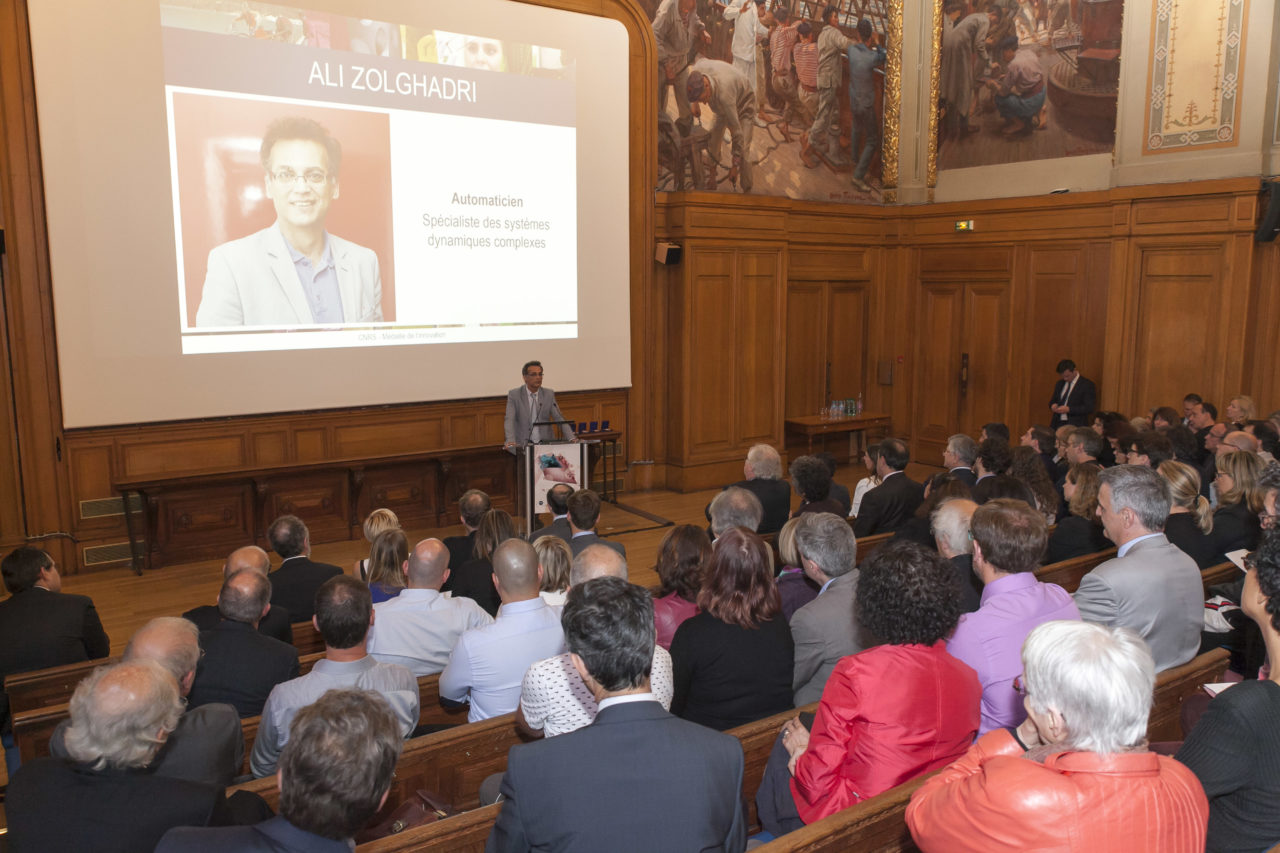

Born in the sixties near Persepolis, my journey has taken me from the heart of ancient Persia to Control Systems Engineering at the University of Bordeaux, France, where I serve as an Exceptional Class Professor — a grand title that mostly means I have spent decades wrestling with control equations and corrupting innocent young minds into doing the same. Since 2024, I have also held a Fundamental Chair as a Senior Member of the “Institut Universitaire de France“. At the IMS Lab, my current research focuses on developing hybrid frameworks that combine model-based and data-driven methods to enhance the safety and autonomy of cyber-physical systems, especially in aerospace. Over the years, this has yielded 280+ publications (Scopus h-index=36), 15 patents in aerospace, active roles across IFAC, IEEE (senior member), and EuroGNC, editorial roles, and keynotes at international congresses. In 2016, I became the first control engineering researcher in France to win the CNRS Medal of Innovation, honoring research with major technological and societal impact (though I suspect the panel was just relieved that theoretical control math ended up certified in a real world safety-critical system). Earlier, in 2010, I received the National Aerospace Research Foundation award. I am married to Brigitte, and we have two children: Tania and Sacha. Off the clock, my ideal evening requires very little: smooth jazz, a fine Bordeaux, and chats on Popperian falsifiability, climate change, or relativistic time — with social media kept strictly out of the loop to keep my own entropy low. Wikipedia page (French) : https://fr.wikipedia.org/wiki/Ali_Zolghadri. (Last update: August 25, 2026).
 Né dans les années 60 près de Persépolis, mon parcours m’a mené du coeur de la Perse antique à l’automatique à l’Université de Bordeaux, où je suis Professeur de Classe Exceptionnelle (PREX2). Je suis également membre senior de l’Institut Universitaire de France (Chaire Fondamentale) pour la période 2024-2029. Je suis marié (Brigitte) et j’ai deux enfants (Tania et Sacha). J’aime le jazz, les grands vins de Bordeaux et l’épistémologie de Popper – mais je n’aime pas les réseaux sociaux ni les anniversaires. Au laboratoire IMS (U-Bordeaux/CNRS), mes recherches portent sur les méthodes visant à garantir que les systèmes cyber-physiques restent plus sûrs, plus autonomes et strictement cohérents avec la physique et les données expérimentales, avec des applications principalement tournées vers les domaines aérospatial et aéronautique. Au fil des ans, cela s’est traduit par 280+ publications (Scopus h-index= 36), 15 brevets dans le domaine aérospatial, des rôles actifs au sein de l’IFAC, de l’IEEE et d’EuroGNC, des participations aux comités éditoriaux de plusieurs revues internationales, ainsi que de nombreuses conférences invitées lors de congrès internationaux. Je suis lauréat de la médaille de l’innovation du CNRS en 2016 qui récompense, toutes disciplines confondues, “des personnalités dont les recherches exceptionnelles ont eu un impact significatif sur le plan technologique, économique, thérapeutique ou sociétal, valorisant la recherche scientifique française”. J’ai l’honneur d’être le premier chercheur en Automatique en France à avoir été distingué par ce prix. Auparavent, en 2010, j’ai reçu un prix d’excellence en recherche aérospatiale décerné par la fondation nationale de la recherche pour l’aéronautique et l’espace. Page wikipédia : https://fr.wikipedia.org/wiki/Ali_Zolghadri. (Dernière mise à jour: 25 aout 2026).